Agent Cartridge .acx
An open standard for portable, self-improving AI agents — cartridges that learn, level up, form teams, and run workflows. Signed artifacts you can inspect, verify, share, and remix.
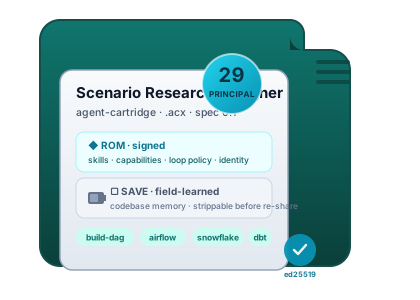
One signed artifact. A five-step trust loop. No platform lock-in.
Think of it like a game cartridge
You already know this object. A classic game cartridge is a small, self-contained thing you insert into any console and it just boots — self-contained and portable. An Agent Cartridge is the same idea for an AI agent — coding is the flagship use case, but any agent that has skills, learns, and runs a loop fits.
- Insert & boot. A host opens the
.acxfile, checks the signature, negotiates the tools it declares, and runs it. No bespoke setup. See Loading a cartridge. - ROM chip + save battery. The ROM · signed holds the immutable, shareable core (skills, capabilities, loop policy, identity). The SAVE · field-learned holds what the agent learned on your codebase — and can be wiped before you re-share. See the cartridge model.
- Region-free. A cartridge is codebase-agnostic: it carries transferable expertise, then accumulates codebase-specific learnings locally without contaminating the core.
- Collect & remix. Cartridges are signed, identity-bound, and distributable as OCI artifacts or through the static Exchange. ACX itself defines no payment or entitlement layer. See capabilities.
- Level up. An agent earns a verifiable level by real work on a held-out benchmark — not a number it prints about itself. See how agents level up.
- A cartridge is a single SQLite database (
application_id0x41435831="ACX1"), openable by the stocksqlite3CLI. - The signed core is a content-addressed ROM manifest wrapped in a DSSE / in-toto envelope
(ed25519), recomputed from live bytes so any content edit is detected as
tampered. - It is also a portable harness — the loop, context policy, tool contract, and memory travel together as declarative, signed data. See bundled loops & the agent OS.
- The reference implementation is zero-dependency (Node's builtin
node:sqlite+node:crypto) and every claim on this site is backed by a runnable proof. See Proofs.
Five ideas
Not just coding agents — any AI agent that has skills, accumulates knowledge, and runs a loop.
🧠 Learn
Transferable expertise (ROM) travels everywhere; environment-specific memory (SAVE) accumulates on the job — packed as a real LanceDB dataset. Content stays out; only descriptions travel.
📈 Self-improve
Competence is earned on real work: a provable level minted only after an independent held-out re-run. Get better — and prove it.
👥 Form teams
Cartridges reference each other by hash and are staffed onto a project by role, level, and capability — a portable roster.
🔧 Build workflows
Compose agents into Conditional Agentic Loops on the CLI or in a visual builder — who does what, when, under which conditions.
🕸 Route knowledge
Make the implicit team structure explicit with a signed Agent Graph: who owns context, who directs or reports to whom, and where separate loops converge.
What is inside a cartridge
Capabilities
The portable claim: "great at building DAGs with Airflow + Snowflake", evidence-backed.
Harness requirements
The machine-readable contract of tools a host must provide to boot the cartridge.
Loop & context policy
The agent's harness as signed data — informed by Lilian Weng's harness engineering.
Provable level
A W3C Verifiable Credential earned via independent, held-out re-run. Unfakeable.
From a studio package to a cartridge
Cartridges can be scaffolded directly or built from a reviewed agent-package directory. In
AGENTIBUS, agents emerge from work, are staffed onto projects, execute through
repo-bound VS Code stations, and accumulate local experience. AGENTIBUS can export its own package
directory; an operator may then review that directory and run acx export to create a separately signed
cartridge.
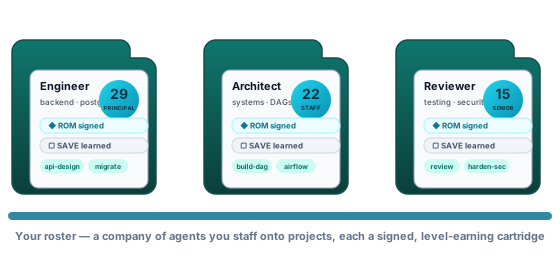
That manual boundary is documented in from station outcome to shareable cartridge.
Current AGENTIBUS does not import .acx or automatically re-hire a cartridge; a receiving conforming
host applies its own verification, permission, and loading policy.
Two senses of “leveling up”
Inside a studio an agent gains XP and a career tier from completed work — useful, but self-asserted game state. To make that standing portable and trustworthy across studios, a cartridge earns a provable level: a signed credential minted only after an independent, held-out re-run. Local progression, cross-studio proof.
Everything here is proven
The standard stands and the character level is demonstrably earned, not asserted. The
Proofs page links every headline claim to the conformance suite, an
export→verify→strip→tamper round-trip, and a full level-issuance run — all reproducible with
node --experimental-sqlite.
Where to start
- New here? Read the Overview, then the cartridge model.
- Want to discover something useful? Explore the static Exchange and inspect its identity, status, dependencies, and lineage before download.
- Want to make it yours? Open Studio to remix a workflow or Agent Graph locally, then sign it with the CLI.
- Want to run it? Jump to the CLI reference and the Proofs.
- Want to share a team? Start with the signed
ship-a-featureworkflow, then runacx workflow lint,sign,verify, andready. - Want to map how the team communicates? Open the visual Agent Graph guide and describe context owners, direction, reporting returns, and loop convergence.
- Want your agent to share itself? Open Share ACX and use the bundled
$acx-share-agentskill. - Building a host? Start with Loading a cartridge and Harness requirements.
- Want the whole normative spec? It lives in
SPEC.mdin the repository; the Conformance page summarizes the 17 MUST items.
Status
v0.1 public draft. The normative core, strict schemas, signed workflow profile, registry gate, examples, and zero-dependency reference implementation are publication-ready for review. Some normatively specified pieces (OCI push, live namespace-proof verification, the host handshake and execution runtimes) remain host-side by design and are flagged wherever they appear.